Last Updated: October 29, 2026
Quick Summary
A commercial kitchen ventilation system combines hood, fan, ductwork, and filters to capture heat, grease, smoke, and odors at the source and move them outside the truck. This 2026 review covers Type I versus Type II hoods, NFPA 96 compliance, CFM calculation, makeup air, and long-term operating costs for food truck owners.
- Type I hoods handle grease and smoke; Type II hoods handle only heat, steam, and moisture.
- NFPA 96 requires a listed hood, working fire suppression, accessible ductwork, and documented cleaning.
- Calculate CFM from the hood’s exposed perimeter in feet times the listing’s rate per linear foot.
- Every CFM exhausted must be replaced by a makeup air unit to avoid negative pressure.
- Ask whether a quote includes a VFD, duct access panels, and filter replacement costs.
What 2026 Commercial Kitchen Ventilation Systems Get Right
A commercial kitchen ventilation system is the combination of hood, fan, ductwork, and filters that captures heat, grease, smoke, and odors at the source and moves them outside the truck. Get it wrong and you fail inspection. Get it right and your cooking line stays workable through a full service.
This commercial kitchen ventilation systems review in 2026 covers how builders treat airflow as one connected system rather than a box bolted over a grill.
Below, we break down hood types, code requirements, CFM math, and operating costs.
Type I vs. Type II Hoods: Which One Your Menu Requires
Type I hoods handle grease and smoke from cooking that produces both. Type II hoods handle heat, steam, and moisture only. The menu decides which one you need, not the budget.
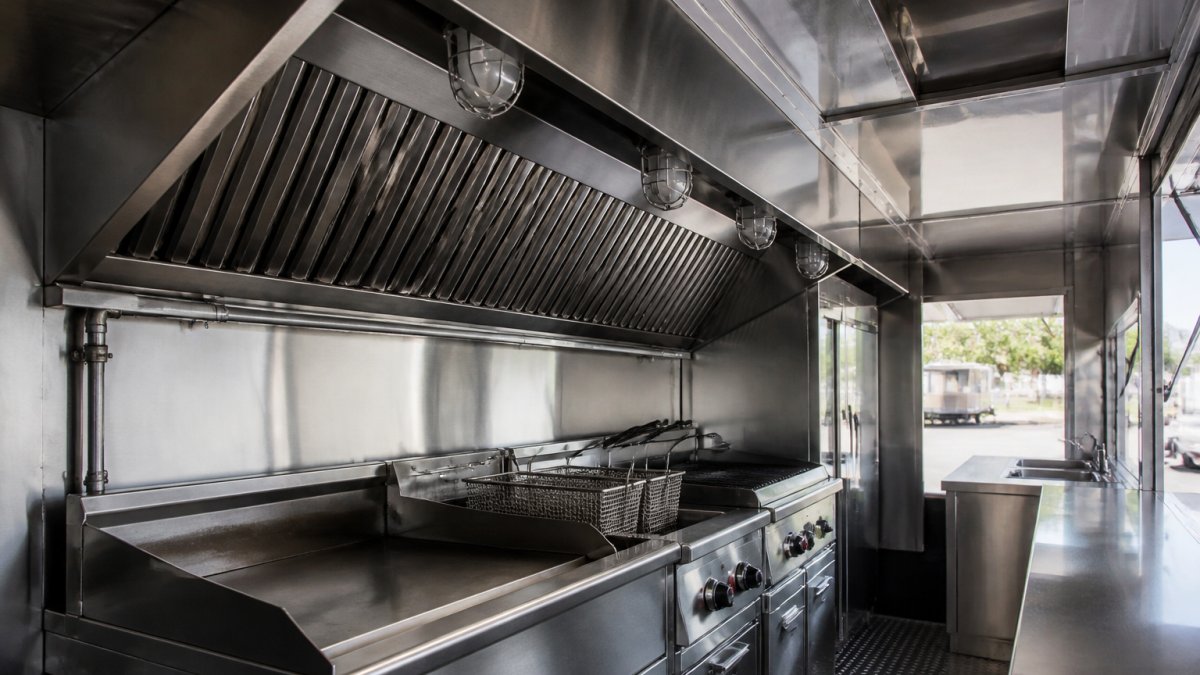
A common mistake is ordering a Type II hood to save money on a truck that will run a flat-top. Hood View shows a real hood installation so you can picture which type fits your menu. It will fail a health inspection and void your fire suppression coverage. NFPA 96, Standard for Ventilation Control and Fire Protection of Commercial Cooking Operations treats grease-producing cooking and non-grease cooking as separate categories for exactly this reason.
Stainless Steel Grades That Survive Daily Commercial Use
Not all stainless is equal, and the grade you choose decides how long the hood canopy survives grease, heat, and daily scrubbing. For commercial kitchen hoods, 430 stainless is common on budget builds, while 304 stainless resists corrosion far better in the wet, greasy environment of a working truck.
What most guides miss is the gauge. Thinner panels dent and warp under heat cycling, and a warped hood canopy breaks the seal that capture depends on. We specify heavier gauge on the canopy and lighter gauge on non-structural trim, because that is where the money buys durability.
Watch out: a magnet sticks to 430 stainless but not to 304. It is a fast field check when a supplier’s paperwork is vague.
NFPA 96 Compliance for Food Trucks: The Rules That Matter
NFPA 96 compliance for food trucks means meeting the same ventilation, cleaning, and fire protection standards as a brick-and-mortar kitchen, adapted to a moving vehicle. Inspectors look for a listed hood, a working fire suppression system, accessible ductwork, and documented cleaning.
The parts that trip up mobile operators:
- Fire suppression. Cooking equipment under a Type I hood needs a listed suppression system with thermal sensors and manual pull station.
- Duct access. Ducts must be accessible for cleaning and inspection.
- Filter placement. Grease baffle filters must be in place and correctly angled.
A reader checking these rules usually wants to see how it looks in a real build. Our fire suppression system installation for a new food truck walks through a completed setup.
Commercial Kitchen Hood CFM Calculation Without the Guesswork
Commercial kitchen hood CFM calculation starts with the hood’s linear footage and the cooking equipment beneath it. CFM, or cubic feet per minute, is the airflow rate the exhaust fan must move to capture and contain smoke and grease. Get this number wrong in either direction and the system fails: undersized, and smoke rolls out of the hood into the cabin; oversized, and you pull conditioned air out faster than the makeup air unit can replace it.
The practical method most designers use:
- Measure the hood’s exposed perimeter in feet, the open sides that actually draw air, not the wall-backed sides.
- Apply the ventilation rate your hood listing specifies per linear foot of that exposed perimeter.
- Add for heavy-duty equipment like charbroilers, woks, or open-flame grills, which the listing rates at a higher duty level.
- Confirm the exhaust fan and ductwork can actually move that volume at the static pressure the run creates.
Do not guess the number. A hood rated for light duty will not capture a searing steak, and an oversized fan wastes money and pulls too much conditioned air out of the truck. The airflow velocity at the hood face matters as much as the total CFM, a big number through a small opening still leaves a weak capture zone at the cooking surface.
A Worked Example
Take a truck with a 6-foot hood open on three sides over a flat-top griddle and a two-basket fryer. The exposed perimeter is 6 ft (front) + 2 ft (left) + 2 ft (right) = 10 linear feet. If the hood listing calls for a medium-duty rate per linear foot, multiply that rate by 10 to get the design CFM. Then check the fan curve at the static pressure of your duct run, a short straight run to a roof fan behaves very differently from a long run with two elbows and a roof curb. If the fan cannot hit the design CFM at that pressure, you either upsize the fan or shorten and straighten the duct. Both are cheaper to decide on paper than after fabrication.
The Makeup-Air Half of the Equation
Most CFM guides stop at the exhaust fan. That is only half the system. Every CFM you exhaust has to be replaced by a makeup air unit (MAU), or the truck goes negative. A common design target is to supply most, not all, of the exhaust volume as tempered makeup air, leaving a small negative bias so cooking odors leave the cabin rather than drifting into it. If you size the exhaust at the hood listing and ignore the MAU, you have sized half a system.
ASHRAE guidance on commercial kitchen ventilation is the reference designers use for these rates. Your hood manufacturer’s listing should always win over a rule of thumb, and your local mechanical code official has the final say on what the plan reviewer will accept.
HVAC Integration and Makeup Air Units: The Hidden Cost of Negative Pressure
Negative pressure is what happens when your exhaust fan pulls more air out of the truck than comes back in. The truck becomes a vacuum. Doors fight you, burners burn poorly, and the HVAC system works against a losing battle.
Makeup air units, or MAUs, solve this by bringing in replacement air at a controlled rate. This is the gap most ventilation reviews skip, and it is where budgets quietly break. A truck without makeup air will pull outside air through every crack, including around your service window and door seals.
HVAC integration means planning the exhaust, the MAU, and the truck’s heating and cooling as one system. If you are planning a build, our design services map airflow and makeup air before fabrication starts.
Watch out: skipping the MAU to save money on the build usually costs more in equipment wear and uncomfortable staff.
Food Truck Ventilation Maintenance Checklist for Every Operator
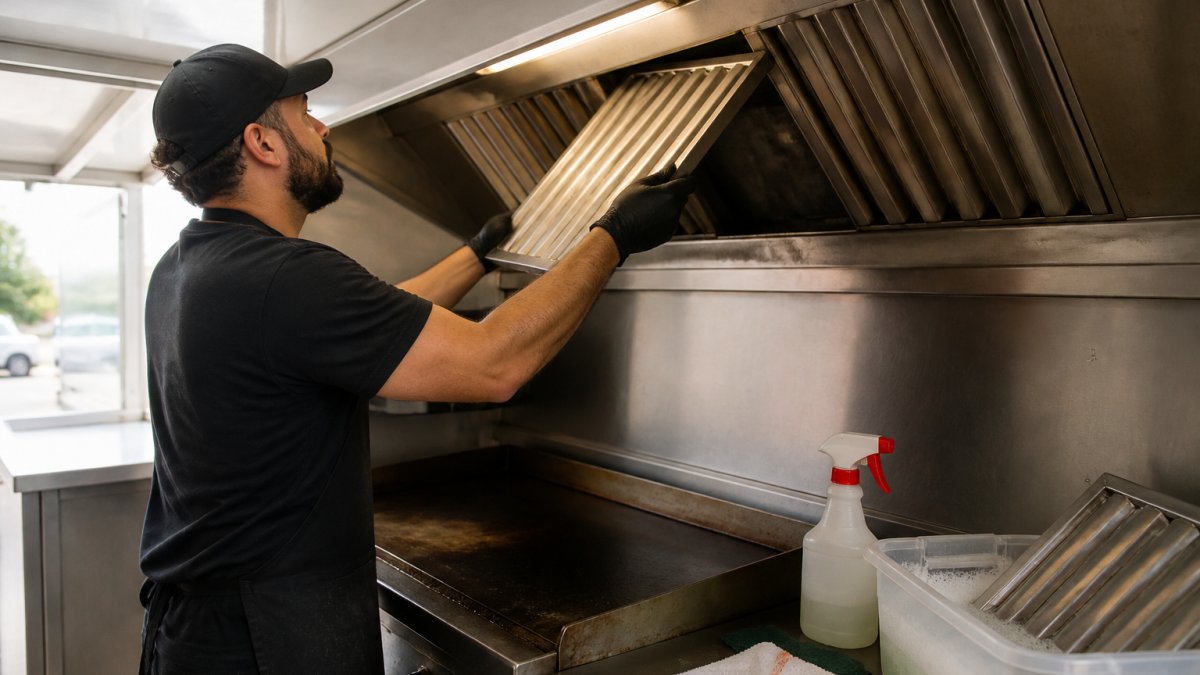
Run this checklist on a schedule:
- Daily: Wipe the hood canopy and check that baffle filters sit correctly.
- Daily: Empty the grease cup and oil cup before service.
- Weekly: Soak grease baffle filters in degreaser and scrub the hood interior.
- Monthly: Inspect the exhaust fan and blower motor for grease buildup and check belt tension.
- Quarterly: Have ductwork inspected and cleaned by a qualified technician.
- Annually: Test the fire suppression system and confirm thermal sensors respond.
Document every cleaning. Inspectors ask for records, and a log protects you.
Here is the maintenance schedule the article lays out, from daily wipe-downs to the annual suppression test.
| Frequency | Task |
|---|---|
| Daily | Wipe hood canopy and check baffle filter placement |
| Daily | Empty grease cup and oil cup before service |
| Weekly | Soak grease baffle filters in degreaser and scrub hood interior |
| Monthly | Inspect exhaust fan and blower motor, check belt tension |
| Quarterly | Have ductwork inspected and cleaned by qualified technician |
| Annually | Test fire suppression system and confirm thermal sensors respond |
Energy Efficiency, Noise, and Long-Term Operating Costs
Most ventilation reviews compare purchase price and stop there. That is the wrong number. The cost that actually decides whether a system was a good buy is total cost of ownership: energy draw, filter replacement, professional duct cleaning, and the labor hours your staff spend fighting a system that was specified badly. This is the gap the top-ranking guides skip, and it is where a cheap quote turns expensive.
Energy Draw
A blower motor that runs at full speed all day draws more power and adds heat to the cabin, heat your HVAC then has to remove, which costs more power. Variable speed control lets you match fan speed to the cooking load: high during the lunch rush, low between orders. The savings come from two places at once, the fan motor itself and the reduced cooling load. Ask for a fan with a variable-frequency drive (VFD) and confirm the hood listing and fire suppression sequence allow reduced speed, some suppression systems require full exhaust on activation, and the control sequence has to respect that.
Noise
Noise matters more in a truck than in a building. The exhaust fan sits close to the operator, and a loud decibel level makes service miserable and drives good staff away. Look for a fan rated for the noise you can live with, mount it with isolation to reduce vibration, and route the duct so the fan is not directly over the pass. A VFD helps here too: lower speed is quieter speed.
The Three Recurring Costs
Long-term ROI comes down to three things you will pay for every year the truck operates:
- Energy. Fan motor plus the HVAC load the fan creates. A VFD and a correctly sized fan both reduce this.
- Filter replacement and cleaning. Baffle filters degrade with repeated degreasing; budget for replacement on a schedule, not when they fail.
- Duct cleaning. Accessible ductwork with proper access panels gets cleaned faster and cheaper. Ductwork you cannot reach gets cleaned late, or not at all, and that is a fire risk, not just a cost.
A well-specified system with accessible ductwork costs less to maintain over its life than a bargain system you cannot clean. That is the trade most buyers miss when comparing quotes, because the cheap quote hides its cost in the years after installation.
How to Compare Two Quotes
Put both quotes on the same page and ask four questions of each: What is the fan’s rated power draw at design CFM? Does it include a VFD? Are the duct access panels specified and reachable? What is the filter replacement interval and unit cost? A quote that answers all four is comparable. A quote that answers none is a price, not a system.
Spec Your Ventilation System With Titan Trucks Mfg
Ventilation is a design decision that touches your menu, permits, and operating costs. Titan Trucks Mfg was founded by former food truck operators.
Every build includes two years of free consulting, and our team helps with layout planning, equipment selection, and guidance on permits and health codes. When you are ready to plan your system, request a quote. You can also explore custom food trucks.
Frequently Asked Questions
What are the NFPA 96 requirements for food truck ventilation?
Check with your local fire authority for the requirements that apply to your food truck.
How do I calculate the CFM needed for a commercial kitchen hood?
Use the hood’s linear footage of cooking surface multiplied by 100 CFM per linear foot for wall-mounted hoods, or 200 CFM per linear foot for island hoods, as a starting point. A 6-foot wall hood over a griddle and fryer needs roughly 600 CFM. Then confirm your blower motor can hold that airflow against static pressure from the ductwork and filters, and add makeup air so the truck does not run under negative pressure. Undersizing shows up as smoke rolling out of the hood during a rush.
What is the difference between Type I and Type II ventilation hoods?
Type I hoods handle grease-laden vapors from fryers, griddles, and charbroilers. They use stainless steel grease baffle filters, a grease trough and oil cup, and require a fire suppression system under NFPA 96. Type II hoods handle steam, heat, and moisture from ovens, steam tables, and dishwashers, with no grease filtration or suppression. Most food trucks need a Type I hood over the cooking line and may add a Type II hood over prep or warewashing areas. Installing a Type II hood over a fryer will fail inspection.
How often should commercial kitchen ventilation systems be professionally cleaned?
NFPA 96 sets cleaning frequency by cooking volume and fuel type. Solid-fuel cooking requires monthly cleaning, high-volume grease cooking every one to three months, and moderate-volume cooking every six months. A food truck running a fryer and griddle most days typically falls in the one-to-three-month range. Between professional cleanings, wipe the hood canopy, empty the oil cup, and degrease baffle filters weekly. Keep the cleaning records on the truck; inspectors ask for them.
Your menu sets the hood type, the hood sets the CFM, and the CFM sets your makeup air and fan. Get that chain right and the rest of the build follows. Get it wrong and you will fight it every service.
Titan Trucks Mfg designs and fabricates mobile kitchens with ventilation planned from day one, backed by two years of free consulting and help with permits and paperwork. Get started with Titan Trucks Mfg and build a truck that breathes as well as it cooks.