Quick Summary
The best support for compliant trailer sourcing combines a clear definition of your operation, verified towing and payload numbers, and a builder who handles documentation and compliance. Confirm permits, VIN paperwork and equipment placement before you sign, and structure payments around documented milestones. Owners who check these steps early avoid costly delays in registration and launch.
- Define your operation, service model and logistics in writing before talking to any builder.
- Confirm the tow vehicle’s maximum towing rating, payload and the loaded trailer weight before buying.
- Verify the VIN, identification plate and component certifications match your documents at delivery.
- Ask whether the builder prepares plan submissions and helps coordinate health and fire reviews.
- Tie payments to milestones such as design approval, frame completion and documentation handover.
Table of Contents
- Why Compliant Trailer Sourcing Matters for Your Business
- Defining Your Trailer Needs by Business Operation
- Understanding Trailer Types and Intended Uses
- Towing Capacity, Vehicle Compatibility and Payload
- Food Truck Permits and Licenses to Check Before You Buy
- Registration, Identification Plates and Documentation
- Food Trailer Equipment Checklist for Compliance and Operations
- Questions to Ask a Food Truck Builder Before Signing
- Supplier Due Diligence and Procurement Risk
- Total Cost of Ownership and Budgeting for Your Trailer
- Food Trailer Sourcing Checklist: Your Next Steps with Titan Trucks Mfg
- Frequently Asked Questions
Compliant Trailer Sourcing: A Guide for Business Owners
Last Updated: November 8, 2026
Why Compliant Trailer Sourcing Matters for Your Business
Compliant trailer sourcing is the process of buying a trailer that meets the federal, state and local rules that govern its build, registration and use. Owners often focus on the look of a unit and the speed of delivery, then discover that a missing document or an uncertified component can stall their launch for weeks. Getting the sourcing right at the start is far cheaper than fixing it later.
Trailer sourcing becomes more complicated when the trailer is a commercial asset. A personal utility trailer may only need a title and a plate, but a food trailer or commercial concession unit is usually subject to vehicle, health and fire requirements on top of that. You need to know which of those apply before you sign anything.
The real risk is not the trailer itself. It is the paperwork trail behind it. A builder who cannot show you clear documentation for the frame, the axles and the vehicle identification number puts your registration, your insurance and your permits at risk. Our advice is simple: treat documentation as part of the product, not an afterthought.
This guide walks through the decisions that matter most, from defining your operation to supplier due diligence, and it ends with a checklist you can use before you commit.
Defining Your Trailer Needs by Business Operation
The right trailer depends on what you will actually do with it. A catering company that loads prepared food for off-site events needs different storage, prep space and power than a single-operator coffee concept that serves customers at one location. Start by writing down how the business will run on a typical day, including how many people work the unit, what menu you will prepare on board and how often the trailer will move.
Break your needs into three categories. First, the operation itself: cooking methods, refrigeration, hot holding, handwashing and waste handling. Second, the service model: walk-up windows, event service, or a combination. Third, the logistics: how far you will travel, what vehicle will tow the trailer, and where it will park overnight.
Owners of established catering companies often find that a second trailer solves more problems than a larger one. A smaller unit that is easier to tow and park can handle short-distance events, while a larger unit covers high-volume work. Capture these tradeoffs in writing before you talk to any builder, because the answers will shape the layout, the axle rating and the length you can legally run on your roads.
Finally, plan for growth. A trailer that fits your menu today may be too small after a successful first season. Ask whether the design allows for added equipment, and whether the frame and electrical system can handle a larger generator or additional appliances.
Understanding Trailer Types and Intended Uses
Trailers fall into a few broad categories, and each category is built for a different purpose. Utility trailers haul materials and equipment. Enclosed cargo trailers protect goods from weather and theft. Concession and food trailers are purpose-built commercial units with cooking equipment, service windows and interior finishes that meet health standards.
The category matters because it determines how the trailer is classified, which inspections it needs and which permits you will request. A trailer intended only for transporting goods is treated differently from a unit used to prepare and sell food to the public. If the trailer will serve customers, expect the health department to review its design before it opens.
Frame construction and axle rating also depend on intended use. A heavily loaded commercial trailer needs a stronger frame, higher-rated axles and braking that matches its gross weight. Choosing a lighter trailer to save money can leave you with a unit that is overloaded the first time you fill the water tanks and load your equipment.
Ask any prospective builder which trailer type they recommend for your operation and why. A reputable builder will explain the tradeoffs rather than pushing a single configuration.
Towing Capacity, Vehicle Compatibility and Payload
Towing capacity is one of the most common and most expensive mistakes in trailer sourcing. Every tow vehicle has a maximum towing rating set by the manufacturer, and that rating must cover the loaded weight of the trailer, not just its empty weight. A trailer that looks light on paper can exceed the rating once you add water, propane, food, smallwares and equipment.
Payload is the other number to watch. Payload is the combined weight of passengers, cargo and tongue weight the tow vehicle can carry. Tongue weight, the downward force the trailer places on the hitch, can consume a significant share of the vehicle’s payload capacity. Owners often overlook this until the vehicle is already overloaded.
Confirm three numbers before you buy: the tow vehicle’s maximum towing rating, its payload capacity, and the trailer’s gross vehicle weight rating with a fully loaded operation. Ask the builder to provide the trailer’s empty weight and the fully equipped weight so you can compare both against your vehicle’s specifications. If the numbers are close, plan for a larger tow vehicle or a smaller trailer.
Vehicle compatibility also covers the hitch class, the brake controller, the wiring harness and the lighting plug. Mismatched connections are a frequent source of roadside problems, so specify them in the purchase agreement.
Food Truck Permits and Licenses to Check Before You Buy
Permits and licenses are where many food trailer projects stall. Requirements vary by state, county and city, and they often apply to the trailer’s design, not just to your menu. Before you order a unit, confirm which agencies will review it and what they will need to see.
Requirements vary, but a food service license from the local or state health department and approval of the trailer’s plans before construction are common steps. Fire marshals often review fire suppression systems, propane storage and cooking equipment placement. Local jurisdictions may also require a business license, a sales tax registration and a mobile vending permit that determines where you can park and sell.
Some jurisdictions require that the plans be submitted and approved before fabrication starts. Changing a layout after the build is finished can mean rework that costs far more than the original design.
Keep a running list of every permit, the agency that issues it, the documents it requires and the expected processing time. Owners who track this list from the start are better positioned to avoid a finished trailer that cannot legally operate.
Registration, Identification Plates and Documentation
Registration is the process of titling and licensing the trailer with the state motor vehicle agency so it can be legally driven on public roads. Commercial trailers typically need a certificate of title, a registration and a license plate. The paperwork usually includes the manufacturer’s statement of origin or a bill of sale, proof of insurance and a completed application.
The identification plate and the vehicle identification number, or VIN, are central to this process. The VIN identifies the trailer throughout its life, from registration to resale. A builder should provide the VIN, the manufacturer’s identification plate and any certification labels in writing, and you should verify that the numbers on the plate match the numbers on your documents.
Watch for trailers with missing or inconsistent paperwork. Custom builds, imported units and trailers assembled from parts can create VIN discrepancies that delay titling. If a builder cannot explain how the VIN was assigned or where the documentation originated, treat that as a warning sign. Once the VIN and title documents are in order, confirm that the hitch is suited to the trailer and its intended load, since Urgency Trailer Rentals can help frame that next sourcing decision.
Request copies of all documents at delivery and keep them in a single file. If a plate is damaged or a document is lost, the state agency will require a replacement process, which is easier when your records are complete.
Food Trailer Equipment Checklist for Compliance and Operations
Equipment is where compliance and operations overlap. Health inspectors will review your cooking appliances, refrigeration, sinks and ventilation, while your daily workflow depends on whether those items are placed where your staff can use them efficiently.
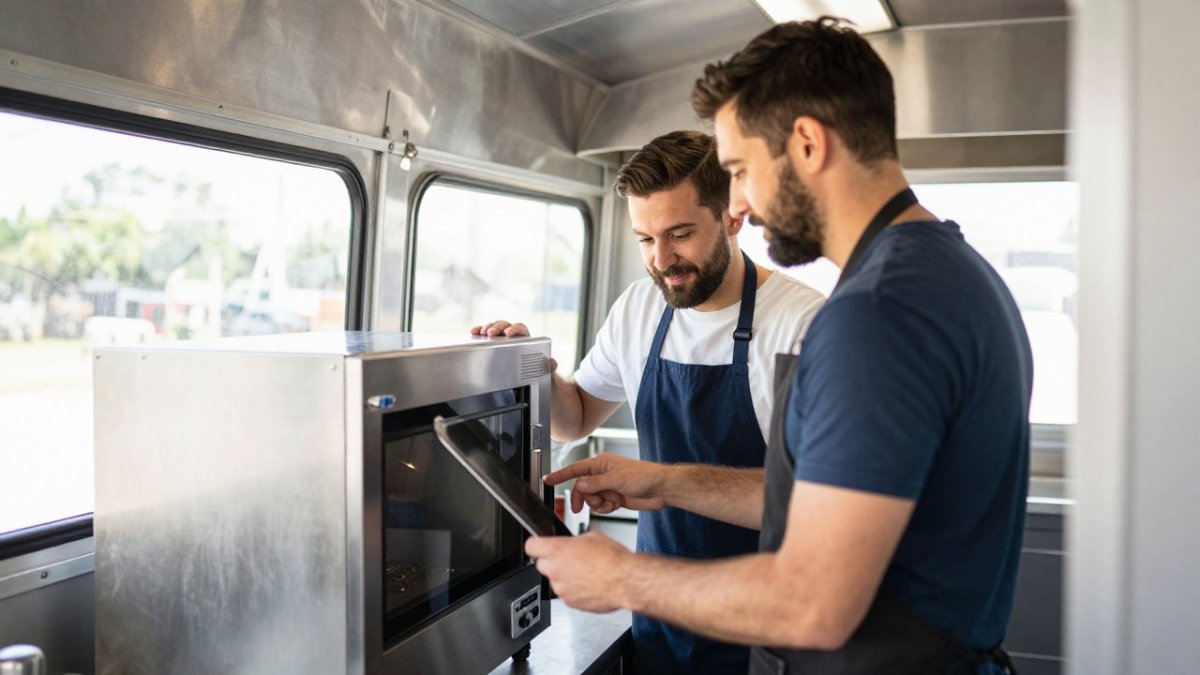
A practical checklist covers the core systems: a commercial cooking line with a hood and fire suppression, refrigeration rated for the expected load, a three-compartment or code-compliant sink, a handwashing station, hot and cold water supply, waste tanks sized for your service volume, and adequate electrical capacity for everything running at once.
Layout matters as much as the equipment list. Place raw and cooked food handling in a sequence that prevents cross-contamination. Keep the handwashing station within easy reach of food prep. Position the propane storage and generator according to the fire code and ventilation requirements in your jurisdiction.
Before you approve a layout, ask the builder to walk you through the placement of each major system and explain how it meets the relevant codes. Get the equipment specifications in writing, including model numbers and certification marks, so the inspector can verify them.
!A food entrepreneur and a fabricator reviewing equipment placement inside a stainless steel food trailer kitchen
Questions to Ask a Food Truck Builder Before Signing
Choosing a builder is a decision you will live with for years, so ask direct questions before you sign. Start with experience: how many trailers has the company built for operators in your category, and can it provide references from clients who have completed a build in your state?
Ask who handles compliance. Does the builder prepare the plan submissions, coordinate with the health and fire reviewers, and assist with registration? Or does it expect you to manage those steps alone? The answer tells you how much of the regulatory burden you will carry.
Ask about documentation. Will you receive the VIN, the manufacturer’s statement of origin, the component certifications and the equipment specifications before final payment? Ask what happens if a document is missing at delivery.
Ask about timelines and warranty. Get the build schedule, the delivery process and the terms for correcting defects. Clarify who pays for rework if an inspector requires a change.
For a detailed quote tailored to your operation, you can request a quote from Titan Trucks Mfg and compare the scope against the questions above.
Supplier Due Diligence and Procurement Risk
Supplier due diligence means verifying that a builder is legitimate, financially stable and able to deliver what it promises, and then structuring the purchase so that risk stays with the builder until the trailer is documented and accepted. It is the step most owners skip, and it is where costly problems usually begin. The top-ranking guides on trailer sourcing stop at “choose a reputable builder”; a business owner needs a repeatable verification process, so this section gives you one.
Stage 1: Verify the entity, not the website. Confirm the company’s legal name, its principal address and its registration with the state authority where it does business. Ask for a certificate of good standing and a certificate of insurance showing general liability and, if the builder delivers trailers on its own equipment, commercial auto coverage. A common pattern is a polished web presence backed by a recently formed entity with no completed builds, the registration date and the insurance certificate will surface that quickly. Watch out: a builder that cannot produce a certificate of insurance naming its coverage limits is asking you to absorb risks you cannot measure.
Stage 2: Verify the build record. Ask for a list of completed units with delivery dates, photos of finished interiors and exteriors (not renderings), and contact information for two or three past clients in your category. Call them and ask three questions: did the trailer pass inspection on the first submission, did the builder respond when something needed correction, and did the final unit match the signed specifications. A builder with a real track record will volunteer references; one without will deflect.
Stage 3: Verify the component trail. Ask where the axles, brakes, frame steel, appliances and electrical components come from, and whether each carries the certification labels your jurisdiction requires. Request the component list in writing with model numbers. This matters because registration and inspection reviewers may check that the trailer’s identification plate and certification labels match the components actually installed. A builder that cannot name its suppliers is asking you to accept risk you cannot measure.
Stage 4: Structure the contract to protect the purchase. The contract should state the specifications, the deliverables, the timeline, the payment schedule and the remedies if a milestone is missed. Tie payments to milestones, design approval, frame completion, delivery and documentation handover, rather than paying in full up front. Specify in writing that the VIN, the manufacturer’s statement of origin, the identification plate and the component certifications are delivered before final payment, and state what happens if a document is missing at delivery. Be cautious of builders who demand full payment before work begins or who will not put specifications in writing.
Stage 5: Plan for delivery and acceptance. Confirm who arranges transport, who bears risk of damage in transit, and what the acceptance process is at handover. Inspect the trailer against the signed specification before you sign the acceptance, photograph the identification plate and VIN, and confirm the documents match the unit. Procurement risk does not end at the contract, it ends when the documented trailer is in your possession and titled in your name.
Run these five stages in order and keep the evidence in one file. If a builder stalls at any stage, that is your signal to slow down rather than to accept a verbal assurance.
Total Cost of Ownership and Budgeting for Your Trailer
The purchase price is only one part of what a trailer costs to own. Total cost of ownership includes permits and inspection fees, insurance, registration, tow vehicle upgrades, fuel, maintenance, propane, generator operation, storage and eventual resale value. Owners who budget only for the purchase often find that operating costs eat into their margins in the first year. The ranking guides on trailer sourcing treat price as a single number; a business owner needs a budget model, so this section shows you how to build one.
Build the budget in four layers. Layer one is acquisition: the trailer itself, any compliance services the builder provides, delivery, and the tow vehicle or hitch and brake-controller upgrades you need to pull it legally. Layer two is one-time setup: permits and inspection fees, initial registration and titling, insurance binders, smallwares and any equipment the builder does not supply. Layer three is recurring operating cost: fuel for the tow vehicle and generator, propane, maintenance and tire replacement, insurance premiums, registration renewals and storage. Layer four is the reserve: a contingency for changes an inspector may require and a repair fund for the first season.
Model the recurring layer over a realistic operating period. Estimate how many events or deliveries you will run per month, the average distance per trip, and the hours the generator will run. Multiply by your local fuel and propane rates to get a monthly operating figure, then add maintenance as a percentage of the trailer’s value per year. A trailer that sits idle still carries insurance, registration and storage costs, which is why the recurring layer often surprises first-year owners.
Compare quotes on scope, not just total. When you receive a quote, ask for a breakdown that separates the base build, optional equipment, compliance services and delivery. Two quotes that look similar in total can differ sharply in what is included, one may bundle plan submission and registration assistance, the other may leave those steps to you. Normalize the quotes by listing every line item each one covers, then price the gaps yourself so the comparison is apples to apples.
Account for resale and downtime. A well-documented trailer with a clean VIN history and complete maintenance records holds value better at resale, which lowers the true cost of ownership. Downtime is the hidden cost: a trailer waiting on a missing document or an inspection correction earns nothing while it sits. Budget for a short buffer before your first revenue date so a paperwork delay does not become a cash-flow problem.
Track actuals from the first season. Record every cost category from month one and compare it against the budget. The variance tells you which assumptions were wrong, fuel, maintenance, permit fees or event volume, and lets you refine the model before you add a second trailer or expand your menu.
Pricing depends on the trailer’s size, equipment, finish level, delivery distance and the scope of compliance work included, so the figures that matter for your business can only come from a formal quote. To see what a food truck costs with a full pricing breakdown, review the dedicated guide before you request your quote. Contact Titan Trucks Mfg for a quote tailored to your specifications, and ask for a breakdown that separates the base build from optional equipment and compliance services.
Food Trailer Sourcing Checklist: Your Next Steps with Titan Trucks Mfg
Compliant sourcing comes down to a few disciplined steps. Define your operation and service model. Confirm your tow vehicle’s towing capacity and payload. Identify every permit and inspection your jurisdiction requires. Verify the VIN and documentation. Review the equipment and layout against code. Vet the builder and read the contract closely. Budget for the full cost of ownership.
Once those steps are complete, you can move forward with confidence. Titan Trucks Mfg was founded by former food truck operators, and every build includes two years of free consulting, along with assistance with permits and paperwork, custom design based on your needs, and nationwide delivery. You can design your build online or request a custom quote and ask about financing options.
Start your build with Titan Trucks Mfg and get a trailer designed around your operation, your compliance requirements and your growth plans. Get A Free Quote.
Frequently Asked Questions
What should business owners look for when sourcing a food trailer?
Start by defining how the trailer will be used: the menu, daily volume, number of operators and the events or routes you plan to serve. Then check the builder’s experience with mobile food units, whether the build is planned around your local health code and permit requirements, and whether the company provides written documentation for the vehicle, including ownership and identification details. Ask for references from past customers and confirm what support is included after delivery. Compare these points across suppliers before you commit to a price, and request a written quote, since pricing depends on specifications, quantity, dates and delivery.
What permits and health-code requirements should food trailer owners check?
Permit and health-code requirements vary by city, county and state, so confirm them with the local health department and licensing offices where you plan to operate. Typical items include a mobile food facility permit, a commissary or prep-location agreement, food handler certifications, and fire safety approval for cooking equipment. Share your equipment layout with the health authority early, because changes made after construction can delay approval. A builder who understands these requirements can help you plan the layout around them.
What questions should you ask a food trailer builder before signing a contract?
Ask who will do the fabrication and whether any work is subcontracted. Request the timeline, the milestones for payment, and what happens if the schedule slips. Confirm what documentation you will receive for the vehicle, including title and identification details, and how the builder handles import or transport paperwork. Ask what post-build support is included, such as consulting access, warranty coverage and repair response times. Clarify whether layout and equipment changes are included in the quote. Get all answers in writing before you sign.
How can you verify that a food trailer meets applicable requirements?
Ask the builder for documentation of how the unit was designed and built, including the equipment specifications and any inspection records. Before the trailer is put into service, have the local health department or fire inspector review it, and keep the approval paperwork on file. Confirm that the registration and identification documents match the vehicle and that the ownership transfer is complete. Independent inspection by a qualified professional before final payment can catch problems that are expensive to fix later.