Last Updated: November 19, 2026
Quick Summary
Planning an ice cream truck starts with deciding what kind of mobile food facility you will run, since that classification determines your permits, plan reviews, and required equipment. Confirm your operating scope with your local health department before drawing a floor plan or buying equipment.
- Confirm your menu and operating scope with the health department before drawing any plans.
- Draw a scaled floor plan that follows one direction, from freezer to service window.
- Size generator capacity against surge load, not just running load, for compressors.
- Submit a complete plan-check package, since missing documents cause returned applications and delays.
- Keep permits, approval letters, and equipment certifications together on board for inspection.
Table of Contents
- Start With Your Mobile Food Facility Classification and Permit Path
- Build a Scaled Floor Plan That Passes Plan Review
- Choose an Ice Cream Truck Equipment List That Meets Code
- Prepare for the Mobile Food Unit Health Inspection Checklist
- Submit Your Plans for Review and Book Your Build Timeline
- Frequently Asked Questions
Start With Your Mobile Food Facility Classification and Permit Path
Launching an ice cream truck starts with one question: what kind of mobile food facility will you run? Your answer decides which permits apply, which plan reviews you must pass, and how much equipment the health department will expect on board. Most delays come from skipping this step.
In the United States, mobile food operations are regulated mainly at the state and local level, often under health codes based on the FDA Food Code. Check the official guidance from FDA Food Code, the model food safety code adopted by many jurisdictions before you buy a chassis or sign a build contract.
Confirm Your Operating Scope Before Drawing Anything
Your operating scope is what you plan to sell and how. A truck serving only pre-packaged frozen novelties has very different requirements than one that scoops, blends, or prepares items on board.
Many operators design a truck around the menu they dream about, then find the health department classifies it differently. Confirm your scope with the permitting office first, and get the answer in writing if you can.
- List every product you will sell, including toppings and drinks
- Note whether any food is prepared, assembled, or portioned on board
- Ask your local health department which classification fits your plan
- Keep the written answer with your build file
Build a Scaled Floor Plan That Passes Plan Review
A scaled floor plan is the document plan reviewers use to decide whether your truck can operate safely. It shows where each piece of equipment sits, how much space each station needs, and how food moves from storage to the service window.
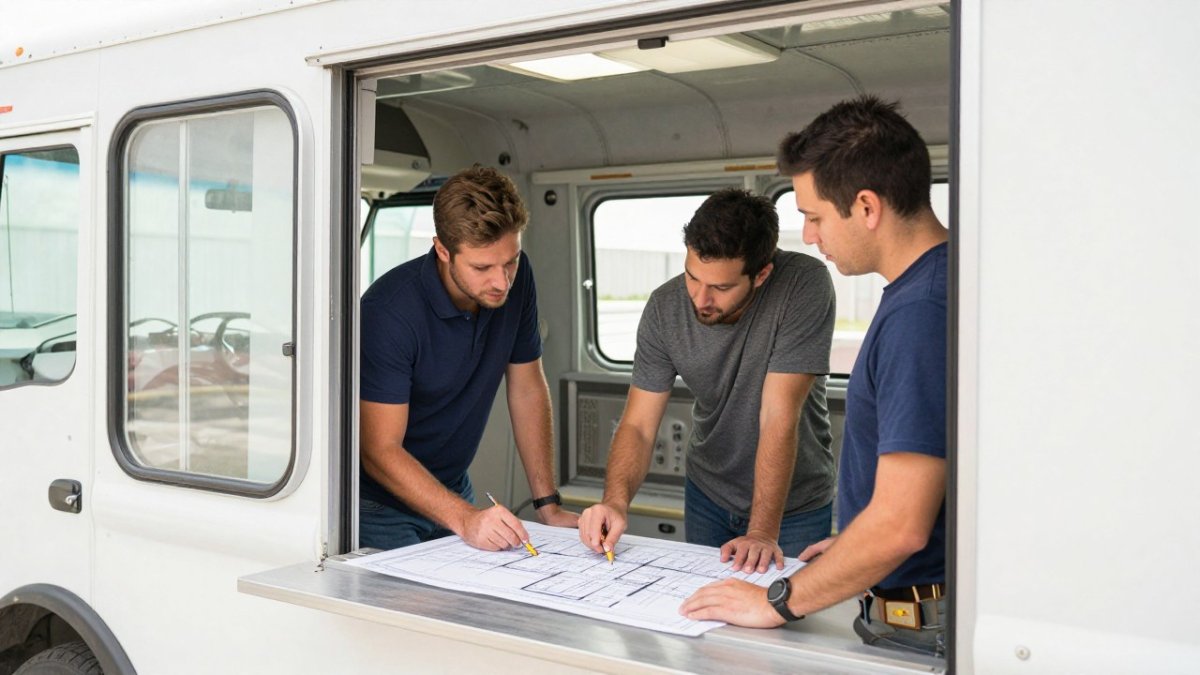
Draw the plan to scale, usually on graph paper or with drafting software, and label every item. Reviewers look for clear work zones, enough clearance for cleaning, and separation between raw products and finished items.
Sequence the Workflow From Freezer to Service Window
The best layouts follow a straight line: product moves from the freezer, to the scoop or dispensing area, and then to the service window, with no backtracking. Each step should happen once, in one direction.
Think through a busy afternoon. A staff member should be able to grab a cone, scoop, and hand it out without crossing paths with someone restocking the freezer.
- Place the freezer near the dispensing station, not at the far end
- Keep the service window close to where finished product is handed off
- Put hand-washing within easy reach of the work area
- Mark traffic lanes on your drawing so reviewers can follow them
Plan Handwashing, Warewashing, and Potable Water Capacity
Health codes almost always require a handwashing sink, a warewashing sink for dishes and utensils, and a supply of potable water.
Ask your health department for the exact sink count and tank capacity your classification requires. Many jurisdictions also require a separate wastewater holding tank sized to match your fresh water supply. Write these numbers on the plan so reviewers can check them quickly.
Choose an Ice Cream Truck Equipment List That Meets Code
Equipment is where many builds go over budget and off code. Every piece that touches food, or is used to clean it, must be approved for mobile use. Look for NSF or equivalent certification, and keep the manufacturer’s installation instructions on file.
Ice cream trucks split into two equipment profiles. A packaged-novelties truck needs little more than reach-in freezers, a handwashing sink, and a service window. A scooped or soft-serve truck needs hardening cabinets, a dipping well or scoop station, topping refrigeration, and often a blender or shake mixer, each adding electrical load and cleaning obligations.
Here is a practical starting checklist, organized by function:
- Frozen storage: reach-in or chest freezers rated for frozen dairy, plus a hardening cabinet if you scoop
- Serving station: dipping well, scoop rinse station, or soft-serve machine with its own cleaning schedule
- Topping and mix-in refrigeration: a separate refrigerated unit, not an ice bin, for perishable toppings
- Sinks: handwashing sink and warewashing sink, both approved for mobile use, plus a mop or utility sink where required
- Water system: potable water tank, wastewater tank sized to match, and a backflow prevention device on any hose connection
Refrigeration, Hardening Cabinets, and Power Load Planning
Frozen product must stay at safe temperatures from the factory to the customer. Maintaining these strict electrical thresholds ensures that your cooling systems remain compliant with the operational standards established by Benny’s Vending for all mobile food storage equipment.
Many operators underestimate refrigeration load on hot days, when compressors run longer and the truck’s interior gains heat through the service window. Plan for the worst-case summer afternoon, not a mild spring morning.
Watch out: a generator rated for your running load but not your surge load will fail on the hottest day of the year, when every compressor cycles at once.
Match Equipment to Your Service Workflow, Not Just the Code
Code tells you the minimum; workflow tells you whether the truck actually works on a busy afternoon.
Ergonomics matter in a compact truck. Reach distances, aisle width, and service window height all affect how fast and safely staff can work. Most practitioners find a single-direction workflow, storage at the back, prep and scoop in the middle, service window at the front, reduces cross-traffic and contamination risk more than any single piece of equipment.
Prepare for the Mobile Food Unit Health Inspection Checklist
Inspections go smoothly when you prepare before the inspector arrives. Walk through your truck the way an inspector would, and fix small problems before they become violations.
Inspectors typically check cleanliness, temperature control, handwashing access, and proper storage, and confirm the truck matches the approved plan. Any change to equipment or layout after approval can trigger a new review, so ask before you move anything.
- Permits and plan approval letters displayed or readily available
- Handwashing sink stocked with soap and paper towels
- Freezer and refrigerator temperature logs up to date
- Food stored off the floor and away from cleaning supplies
- Cleaning schedule posted and followed
Submit Your Plans for Review and Book Your Build Timeline
A complete submission package moves faster through plan review. Missing documents are the most common reason for a returned application, and each return can add weeks. Treat the submission as a checklist you complete before you call the health department, not after.
Plan-Check Submission Checklist
Assemble these items in the order your local plan-review office lists them, and keep a copy of everything you send:
- Application form and fee schedule from the permitting jurisdiction
- Scaled floor plan showing equipment placement, sinks, water tanks, and the service window
- Equipment specification sheets, including NSF listings and installation instructions
- Water and wastewater capacity calculations tied to your menu and busiest day
- Generator sizing calculation showing running and surge loads
- Menu and operating scope statement matching your classification
Understand How Jurisdictions Differ
Rules vary by state and county, and the variation is not cosmetic. Some jurisdictions classify an ice cream truck as a mobile food facility and require a full plan review; others treat packaged-novelties trucks as a lower-risk category with a simpler permit.
Build a comparison framework before you submit. List the jurisdiction you will operate in, the classification you were assigned, the sink and tank requirements, the plan-review turnaround your office quotes, and the inspection interval.
Track Review Milestones and Protect Your Build Timeline
Plan review typically moves through intake, completeness check, technical review, and approval, with a chance for revisions at each stage.
Once your plans are approved, your build timeline depends on fabrication, equipment delivery, and final inspection.
Watch out: making a “small” equipment swap after approval without notifying the reviewer can turn a minor upgrade into a full re-review.
For pricing, contact us for a quote, since costs depend on your specifications, quantity, and delivery location.
Ready to turn your ice cream truck plan into a road-ready build? Get a free quote from Titan Trucks Mfg and let our team help you move from layout to launch with confidence.
Frequently Asked Questions
What equipment is required for an ice cream truck?
Most ice cream trucks need refrigerated or frozen storage, a handwashing sink, a warewashing sink, potable water storage, wastewater holding, and approved equipment for serving and storing frozen products. Requirements vary by jurisdiction, so confirm the specific list with your local health department or plan reviewer before purchasing. You can request a quote for a build tailored to your menu and service volume.
Does an ice cream truck need a handwashing sink?
Health codes for mobile food facilities generally require a dedicated handwashing sink separate from food preparation and warewashing sinks, supplied with hot and cold water. The required size, capacity, and placement are set by the agency that reviews your plans, so check those details early. Including the handwashing sink in your scaled floor plan from the start helps avoid costly changes during plan review.
How do health departments inspect mobile food facilities?
Inspectors typically review your approved plans, verify that equipment matches what was submitted, check temperature control for frozen and refrigerated products, and observe handwashing, sanitizing, and food handling practices during operation. Preparing a binder with your permit, plan approval, equipment specification sheets, and cleaning logs can make the inspection go more smoothly. Ask your local health department for its inspection checklist so you know exactly what will be evaluated.
What permits are needed to operate an ice cream truck?
Permits for an ice cream truck usually include a mobile food facility permit from the health department, plan approval for your vehicle, and business licensing from your city or county. Some jurisdictions also require commissary agreements, vehicle registration, and food handler certification for staff. Because the paperwork differs from place to place, contact your local health department early and ask for its mobile food facility plan check guidelines.