Quick Summary
Clean grease filters daily if you fry all day, weekly for moderate cooking several shifts a week, and every two to four weeks for light use. Check them at the end of every shift, and clean sooner if you see a heavy film. Also do a monthly deep clean and log each cleaning.
- Heavy frying, all-day service: clean filters daily.
- Moderate cooking, several shifts a week: clean filters weekly.
- Light cooking or occasional use: clean every two to four weeks.
- Check filters at the end of every shift, even on a fixed schedule.
- Do a monthly deep clean and log each cleaning to spot patterns.
Table of Contents
- Why Grease Filters Need Regular Cleaning in a Commercial Kitchen
- How Often to Clean Commercial Hood Filters
- Choosing the Best Degreaser for Commercial Kitchen Filters
- How to Clean Fryer Hood Filters Step by Step
- Commercial Grease Filter Cleaning Checklist and Troubleshooting for Mobile Kitchens
- Frequently Asked Questions
How Often Should Commercial Hood Filters Be Cleaned?
Last Updated: October 30, 2026
Why Grease Filters Need Regular Cleaning in a Commercial Kitchen
Grease filters are the first line of defense in any commercial kitchen hood system.
A grease filter catches the oil and fat particles that rise from cooking. When it fills up, airflow drops.
That buildup is the real danger. The National Fire Protection Association (NFPA) sets the standards for commercial cooking exhaust cleaning in NFPA 96, which requires hood systems to be kept clean enough to prevent grease fires. NFPA 96 Standard for Ventilation Control and Fire Protection of Commercial Cooking Operations
Dirty filters also hurt performance in ways you can feel:
- Smoke and heat build up near the cooking line
- The fan motor strains and may wear out early
- Grease drips onto cooking surfaces and prep areas
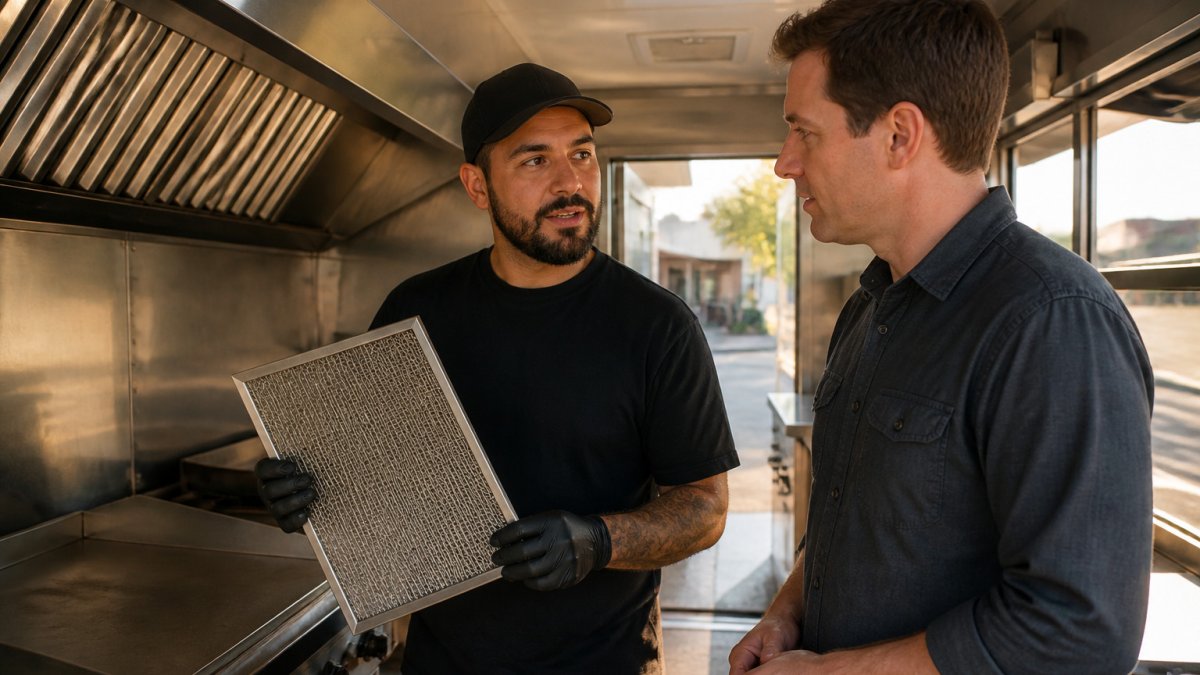
Watch out: A filter that looks clean on the outside can still hold a heavy layer of grease in its mesh. Check both sides before you assume it’s ready to reuse.
How Often to Clean Commercial Hood Filters
No single schedule fits every truck.
A simple starting point:
- Heavy frying, all day service: clean filters daily
- Moderate cooking, several shifts a week: clean filters weekly
- Light cooking or occasional use: clean filters every two to four weeks
Check your filters at the end of every shift, even on a fixed schedule. If you see a dark, heavy film or the filter feels greasy, clean it sooner.
Many operators also do a monthly deep clean to catch grease a quick rinse misses, such as on hood surfaces and the filter frame. Log each cleaning to spot patterns over time.
Choosing the Best Degreaser for Commercial Kitchen Filters
The right degreaser makes filter cleaning faster and safer, but “best” depends on your filter metal, water hardness, and how much polymerized grease you are dealing with. If you are also planning the equipment layout around your cleaning area, you can explore custom concession and food trailer builds that account for washdown space and hood placement. Most commercial hood filters are aluminum mesh, stainless steel mesh, or a galvanized frame with an aluminum mesh insert, and each reacts differently to alkaline and acidic cleaners.
Match the cleaner to the filter metal
- Aluminum mesh and frames: Use a pH-neutral or mildly alkaline degreaser labeled safe for aluminum. Strong caustic cleaners attack aluminum, dull the finish, and can pit the mesh.
- Stainless steel mesh and hood interiors: Mildly alkaline degreasers are generally safe, but check for chloride content, which can cause pitting and rust in a humid mobile kitchen.
- Galvanized frames: Avoid highly acidic cleaners, which strip the zinc coating and leave the frame vulnerable to rust.
Read the label for these five details
- Commercial kitchen claim. The product should be labeled for commercial grease and hood cleaning, not just household degreasing.
- Dilution ratio and contact time. A 1:10 concentrate with a 10-minute dwell is a different tool than a ready-to-use spray with a 2-minute contact time. Follow the label ratio; stronger is not safer and can damage metal.
- Rinse requirement. Some products require a potable-water rinse before the filter goes back in the hood; others are labeled no-rinse.
- Food-contact and ventilation warnings. Read the safety data sheet (SDS) for required PPE, ventilation, and first-aid instructions. Keep the SDS on the truck.
- Material compatibility list. A reputable label names the metals and surfaces the product is safe for. If the label is silent on aluminum, treat it as unsafe for aluminum.
Never mix degreasers with bleach, ammonia, or acidic cleaners. Some combinations release toxic fumes, and the reaction can be violent in a small mobile kitchen. Use one product at a time and rinse between steps.
Plan the soak and rinse area before you start
In a mobile kitchen, the washdown area is usually the limiting factor. Decide where filters will soak and where rinse water will go before you pull the first filter. A dedicated bus tub or shallow pan keeps degreaser off food-contact surfaces, and a grease interceptor or holding tank keeps runoff out of the street or a storm drain. A two-bay setup, one for soaking, one for rinsing, cuts cleaning time and keeps degreaser residue out of the final rinse.
When to step up to a heavier-duty product
If filters come out of a normal soak still tacky or dark in the mesh openings, the grease has likely polymerized, which is harder and less soluble than fresh cooking oil. Use a product labeled for heavy or carbonized grease, extend the dwell time within label limits, and consider a soft brush. If buildup still will not release, the filter may be at the end of its service life, crushed or bent mesh cannot be cleaned effectively and should be replaced.
How to Clean Fryer Hood Filters Step by Step
Fryer hoods collect the most grease, so they need extra attention. Follow these steps for a thorough clean.
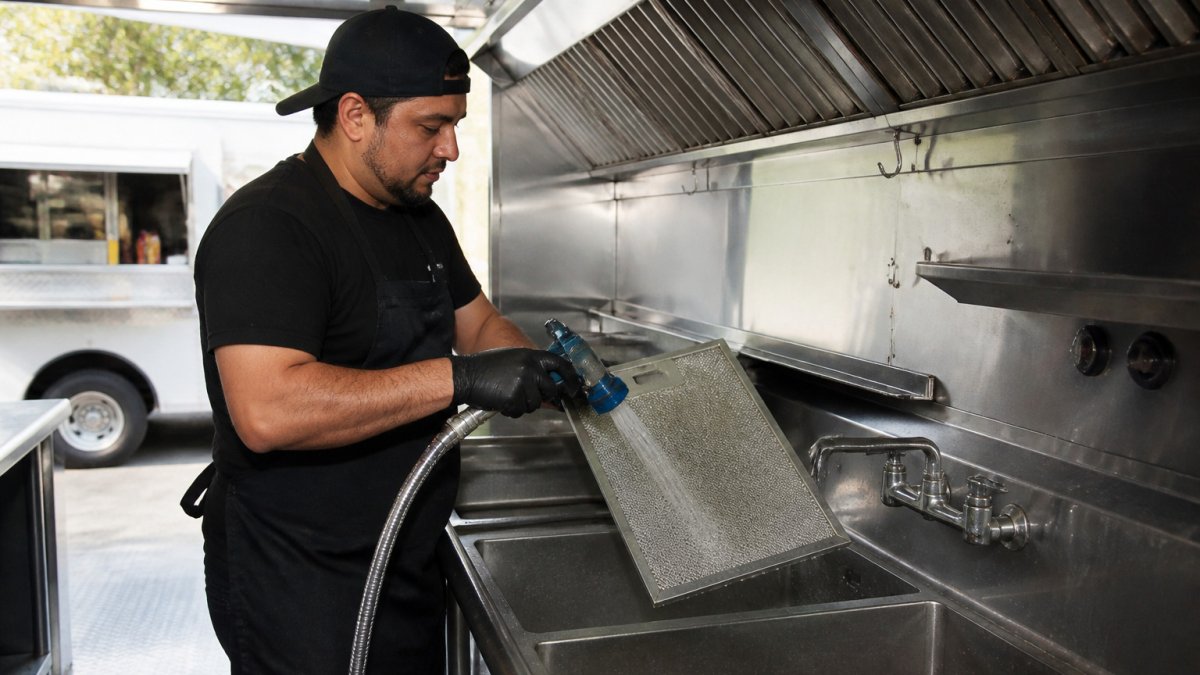
- Turn off the hood fan and remove the filters. Let them cool before handling.
- Pre-scrape the filters. Use a plastic scraper to remove loose grease and food bits.
- Soak in degreaser. Mix to label strength and soak for the listed time, usually 10 to 20 minutes.
- Scrub the mesh. Use a soft brush, especially at corners and edges.
- Rinse thoroughly. Use hot water to remove all degreaser and loosened grease.
- Dry completely. Air dry before reinstalling; wet filters can cause problems in the hood.
- Wipe the hood interior. Clean surfaces where grease collects with a commercial-kitchen-approved cleaner.
- Reinstall and test. Run the fan briefly to confirm normal airflow.
Expected result: The filter mesh should look clear, with no dark film in the openings.
Fryer hoods collect the most grease, so the cleaning process needs a few extra steps to get the filters truly clear.
| Step | What to do | Time or frequency |
|---|---|---|
| Turn off and remove | Turn off the fan and remove filters; let them cool | Before cleaning |
| Pre-scrape | Remove loose grease and food bits with a plastic scraper | Before soaking |
| Soak in degreaser | Mix to label strength and soak | 10 to 20 minutes |
| Scrub mesh | Scrub with a soft brush, especially corners and edges | During soak |
| Rinse thoroughly | Rinse with hot water until all degreaser is removed | Until residue gone |
| Dry completely | Air dry before reinstalling | Before reinstalling |
| Wipe hood interior | Clean grease-collecting surfaces with an approved cleaner | Each cleaning |
| Reinstall and test | Run the fan briefly to confirm airflow | After reinstalling |
Commercial Grease Filter Cleaning Checklist and Troubleshooting for Mobile Kitchens
Use this checklist at the end of each cleaning cycle, then work through the symptom-to-cause guide below when something does not behave the way it should.
End-of-cycle cleaning checklist
- Filters removed and pre-scraped
- Filters soaked in the correct degreaser strength
- Mesh scrubbed, including corners and edges
Symptom-to-cause guide for mobile hood systems
Most hood problems show up as one of five symptoms. Work from the symptom to the likely cause before you touch anything.
1. No power to the fan or controls. Check the breaker, then the disconnect, then the shore-power or generator connection.
2. Weak suction but the fan is running. This is the most common mobile-kitchen complaint, and it is often not a fan problem.
**3. Persistent airflow issues often signal deeper mechanical failures that extend beyond the ventilation system, much like how neglecting restaurant sewer line maintenance can compromise the entire infrastructure of a commercial kitchen.
**4.
**5.
Make-up air and pressure balance: the check most operators miss
A hood fan is half of a pressure system: every cubic foot of air it exhausts must be replaced by make-up air, or the fan will cavitate against a vacuum and capture will drop. In a mobile kitchen, make-up air is often an afterthought, a louver, a small powered fan, or an open window. To check balance safely, close all doors and windows, run the hood fan at full speed, and see whether a piece of tissue or a smoke pencil is pulled toward the hood face.
What operators can check versus what requires a licensed technician
Only inspect what you can see and reach safely with the fan off and power locked out. Do not open fan housings, disconnect wiring, or climb onto the roof of a truck to service a fan. Electrical work, gas work, and fire-suppression system service typically require a licensed technician.
Operators can safely: remove and clean filters, wipe the hood interior, check that filters seat correctly, confirm the breaker is on, and observe airflow with a tissue or smoke pencil. A licensed technician should handle: fan motor and bearing service, belt replacement, wiring and control repairs, make-up air balancing, duct cleaning beyond the hood collar, and any work on the fire-suppression system. NFPA 96 requires the exhaust system to be inspected and cleaned on a schedule by qualified personnel, and the fire-suppression system has its own inspection requirements. NFPA 96 Standard for Ventilation Control and Fire Protection of Commercial Cooking Operations
Log the symptom, not just the cleaning
A cleaning log that records only dates and initials misses the pattern that predicts failures. Add a short symptom note each time something seems off, “weak suction after filter change,” “fan noisy on start,” “smoke at line during lunch rush.” Over a few weeks, those notes show whether the problem is a cleaning interval issue, a make-up air issue, or a failing fan.
If you run into a filter or hood problem you cannot solve in-house, contact Titan Trucks Mfg for help. You can also see examples of hood areas we have built to compare layouts.
Frequently Asked Questions
How often should commercial kitchen grease filters be cleaned?
Most commercial kitchens clean grease filters at least once a month, and high-volume fryer or grill lines often need weekly cleaning. Mobile kitchens that run daily service typically check filters at the end of every shift. Inspect filters regularly for visible grease buildup, reduced airflow, or dripping, and clean them sooner if any of these appear. Keep a maintenance log so the schedule reflects your actual cooking volume rather than a guess.
What is the best way to clean commercial kitchen grease filters?
Remove the filters, soak them in a hot water and degreaser solution, scrub with a soft brush to lift baked-on grease, rinse thoroughly with hot water, and let them dry completely before reinstalling. Work in a sink or designated area with good ventilation and wear gloves and eye protection. Avoid high-pressure sprays that can push grease deeper into the mesh. Check each filter for damage and replace any that no longer seal properly in the hood frame.
Can commercial kitchen grease filters go in a dishwasher?
Some commercial dishwashers can handle grease filters, but many filters are too large or the grease load is too heavy for a standard machine. Grease can also clog drain lines and the dishwasher itself. Soaking and manual scrubbing, or a dedicated filter-cleaning station, is usually more effective. Check your equipment manual before running filters through any dishwasher.
When should a commercial kitchen grease filter be replaced?
Replace a grease filter when the mesh is bent, torn, or corroded, when it no longer fits the hood frame snugly, or when cleaning no longer removes grease fully. Filters that stay saturated after repeated cleanings lose their ability to capture grease and can create a fire hazard. Keep spare filters on hand so kitchen service is not interrupted while a filter is being cleaned.
Keeping grease filters clean is one of the simplest ways to protect a mobile kitchen. Set a schedule, check filters every shift, and log your cleaning. If you are planning a new build or want help getting your hood system right, see why operators choose Titan Trucks Mfg for their mobile kitchens.