Quick Summary
To troubleshoot a food truck hood, check the power first, since most hoods that will not run have a tripped breaker, loose wiring, or a generator or shore power problem. Then inspect the fan and belt, clean grease filters and ducts, and confirm make-up air. Work through these in order so you do not replace a part that is not broken.
- Check the hood breaker and wiring first; a dead fan is most often a power problem.
- A breaker that trips repeatedly signals a short or overload and needs an electrician, not a bigger breaker.
- Tighten or replace a belt that squeals, and test the motor bearings by spinning the fan by hand.
- Clean grease filters and empty the containment cup, then inspect ducts, since grease cuts airflow over time.
- Weak capture with a closed door often means the truck is short on make-up air, not that the fan has failed.
Table of Contents
- Why Food Truck Hood Exhaust Systems Fail
- Step 1: Check Power, Breakers, and Electrical Connections
- Step 2: Inspect the Exhaust Fan and Motor
- Step 3: Clean Grease Filters and Exhaust Components
- Diagnosing Food Truck Hood Airflow Problems and Make-Up Air
- Symptom-to-Cause Diagnostic Guide and Safety Limits
- Booking Your Next Hood Inspection With Titan Trucks Mfg
- Frequently Asked Questions
Why Food Truck Hood Exhaust Systems Fail
A food truck hood exhaust system does one job: pull smoke, heat, and grease vapor out of a cramped kitchen before it builds up.
This guide walks through the same order a technician would use. If your fan or motor has failed, you can also see whether a fire suppression system upgrade or service is available from this builder.
Common causes include:
- No power to the fan, often from a tripped breaker or loose wire
- A broken or slipping fan belt
- A failing motor or bad bearings
The fixes are not always expensive. Many hood problems come down to a breaker, a belt, or a dirty filter. Check those first before you assume the whole system has failed.
Step 1: Check Power, Breakers, and Electrical Connections
Start here. A hood that will not turn on is most often a power problem, not a fan problem. On a food truck the power path is shorter and more fragile than in a brick-and-mortar kitchen: shore power inlet, cord, adapter, transfer switch or changeover plug, main panel, hood circuit breaker, fan disconnect, and the fan motor itself. Work that path in order so you do not chase a fan that never received voltage.
Time needed: About 15 to 20 minutes
Work through these checks in order:
- Confirm the hood switch is on and the fan control is set to run. On many trucks the hood fan and the lights share a control circuit, so a dead control circuit can look like a dead fan.
- Open the truck’s electrical panel and identify the hood fan breaker. Look for a tripped or half-switched position. Labeling matters on a compact panel; if the breaker is not labeled, trace it before you reset anything.
- Reset the breaker once, then turn the fan on. If it trips again, stop and look for a short or overload.
A breaker that trips again and again is a warning sign. Do not replace it with a larger breaker to stop the trips. That can overheat the wiring and start a fire. Match the breaker to the conductor and the fan nameplate, not to the nuisance trip.
Checking the Generator and Shore Power Connection
Food trucks often run the hood from a generator or a shore power connection, so check those too. This is where mobile kitchens diverge most from restaurant guidance.
- Shore power: Inspect the inlet, the cord, and the adapter for damage, heat marks, or a loose twist-lock collar. A partially engaged twist-lock can pass voltage to lights but drop out under the fan’s starting current.
- Generator output: Confirm the generator is running and producing steady output. Check the generator’s own breaker or overload indicator. If the generator is in overload, the hood fan may be the load that pushes it over.
- Load capacity: Compare the hood fan’s nameplate amps (locked-rotor amps for starting) against the generator’s rated output, plus the rest of the truck’s load. A fan that starts on shore power but trips the generator on start is usually a starting-current problem, not a fan failure.
Try the hood on a different power source, if you have one, to rule out the supply. If the fan runs on shore power but not on the generator, the problem is likely the generator’s output, its breaker, or its load capacity, not the hood.
What You Can Safely Check vs. What Needs a Technician
You can safely check breaker positions, visible wiring condition, cord and inlet condition, and generator indicators with the power off. Stop and call a licensed electrician or generator technician for any of the following:
- Burned wiring, a burning smell, or scorch marks at the panel, inlet, or fan
- Repeated breaker trips after a single reset
- Any work inside the panel beyond resetting a breaker
Lock out and tag out the circuit before inspecting wiring. Capacitors in some fan controls can hold a charge after power is removed, so treat control enclosures as live until a qualified person confirms otherwise.
Step 2: Inspect the Exhaust Fan and Motor
Once you know the fan has power, check whether it actually turns and moves air.
Time needed: About 20 to 30 minutes
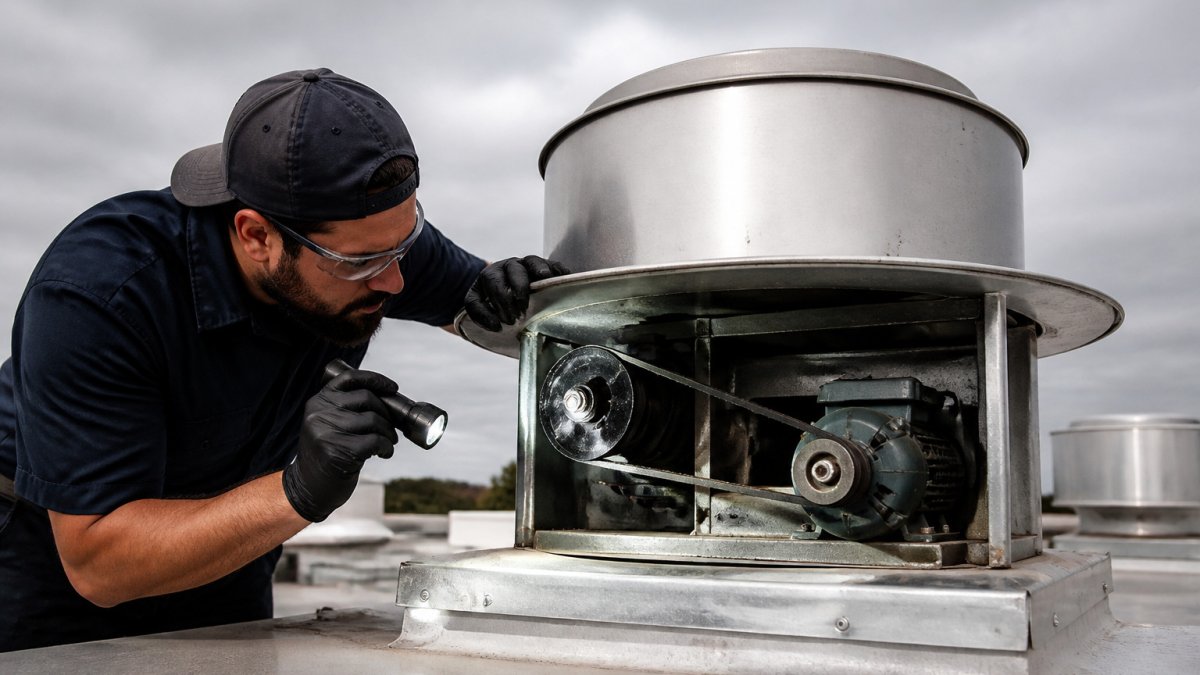
- Turn the fan on and listen for a steady hum with no grinding or rattling
- Check the fan blades for debris, grease, or damage that could cause imbalance
- Look at the belt. It should be snug, with no cracks, glazing, or fraying
Fan Belts, Motor Failure, and Unusual Noise
Belt and motor problems cause most of the noise and weak performance in food truck hoods.
- Squealing: Usually a loose or glazed belt. Tighten or replace it.
- Grinding or rumbling: Often worn bearings in the motor or fan shaft
- Rhythmic thumping: Usually a fan blade loaded with grease, which throws it out of balance
Many people replace a belt when the motor is the real problem, so test before you buy. Spin the fan by hand with power off. If it feels rough or catches, the bearings are likely the cause.
Step 3: Clean Grease Filters and Exhaust Components
Grease is the most common reason a hood loses suction over time. A clogged filter forces the fan to work harder and still moves less air.
Time needed: About 30 to 45 minutes, depending on how dirty the system is
- Turn the fan off and let the hood cool.
- Remove the grease filters and check them for a heavy coat of grease.
- Soak the filters in a degreaser suitable for commercial kitchens, then rinse and let them dry fully.
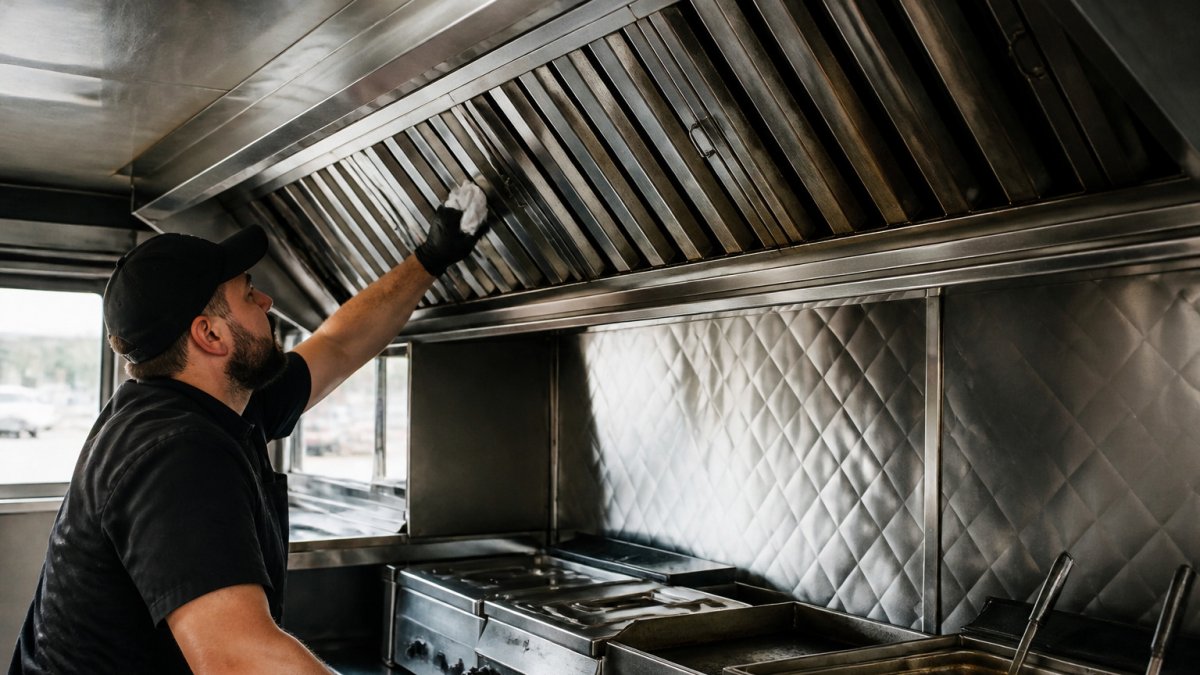
- Wipe the fan blades, housing, and visible duct sections with the same degreaser.
- Check the grease containment cup or tray and empty it. Overflow onto the roof or floor is a fire and safety hazard.
- Reinstall the clean filters and test the fan for smoke capture.
Do not skip the ducts. A clean filter with a greasy duct behind it still leaves a fire risk, and the airflow will stay poor.
Diagnosing Food Truck Hood Airflow Problems and Make-Up Air
If the power, fan, and filters all check out but the hood still does not pull smoke, look at airflow balance. A hood can only exhaust air if fresh air can come in to replace it. In a food truck the cooking space is small and often tightly sealed, so a hood that worked on the lot can fail once the windows are closed or a new appliance is added. Maintaining this equilibrium is essential for preventing unexpected repair bills that often arise when overworked motors burn out due to restricted intake.
Work this sequence before you assume the fan is undersized:
- Confirm the fan is actually moving air. With the fan on, hold a strip of tissue at the hood’s front edge. A firm pull into the hood means capture is working. A tissue that flutters outward or stays still points to airflow balance or a blockage, not necessarily a failed fan.
- Check the filters first. A grease-clogged filter cuts airflow before the fan ever struggles. Clean or replace filters, then repeat the tissue test.
- Check the duct path. Look for crushed flex duct, sharp bends, long runs, or a damper that is closed or stuck. A damper left closed after service is a common and easily missed cause of weak suction.
- Test make-up air. Open a window or door near the cooking line and see if the hood pulls better. If it does, the truck is short on make-up air.
- Check pressure balance. A strong exhaust with no intake can pull air back through the window, the generator vent, or gaps in the truck body. This can also pull exhaust fumes back into the cooking area.
- Check intakes and vents. Confirm vent louvers are open and not covered by equipment, boxes, or grease. Make-up air intakes blocked by stored gear are a frequent food-truck fault.
Recognizing Pressure Imbalance
Pressure imbalance is the gap most general hood guides skip, and it matters more in a mobile kitchen than in a restaurant. Signs include:
- Smoke that curls out of the hood front instead of rising into it
- A door that is hard to open or slams shut when the fan runs
- Whistling at gaps, vents, or the truck body
A simple test: hold a strip of tissue at the hood’s front edge with the fan on. If it pulls firmly into the hood, the capture is working. If it flutters outward or stays still, the problem is likely airflow balance or a blockage. Repeat the test with a door or window cracked open. If capture improves, the truck is short on make-up air.
Make-Up Air for a Compact Kitchen
Make-up air is the fresh air the hood needs to replace what it exhausts. In a food truck, plan it as part of the layout, not as an afterthought:
- Size make-up air to roughly match the exhaust airflow, and provide a path for it to reach the cooking line without crossing the cook.
- Use a dedicated make-up air intake or a controlled opening rather than relying on a propped door, which invites pests and weather.
- Keep make-up air intakes away from generator exhaust, grease dumpsters, and vehicle exhaust.
- If the truck has a make-up air fan, confirm it runs when the exhaust fan runs and that its filter is clean.
Weak capture is not always a fan problem. Check filters, duct path, make-up air, and pressure balance before you replace a motor. Document what you find, because recurring airflow faults usually trace back to a layout or balance issue rather than a single failed part.
Measurable Checks and When to Call a Professional
Operators can document symptoms: tissue-test results with the door open and closed, fan sound and speed, filter condition, and how often the fault recurs. Code-required measurements such as duct velocity, static pressure, and capture velocity should be performed by a qualified technician with the right instruments. Call a professional if capture does not improve after filters, duct, and make-up air checks, if the duct is damaged or undersized, or if the system has never been balanced since installation.
Symptom-to-Cause Diagnostic Guide and Safety Limits
Use this table to match what you see with the most likely cause and the next step.
| Symptom | Likely Cause | Next Step |
|---|---|---|
| Fan does not turn on | Tripped breaker or no power | Check breaker and wiring |
| Breaker trips repeatedly | Short, overload, or failing motor | Stop and call an electrician |
| Squealing or slipping sound | Loose or worn belt | Tighten or replace belt |
| Grinding or rumbling | Worn motor bearings | Test by hand, then replace motor if needed |
| Fan runs, weak suction | Grease-clogged filters or ducts | Clean filters and inspect ducts |
| Smoke pulls back into kitchen | Insufficient make-up air | Open make-up air or check balance |
| Fan vibrates or thumps | Grease-loaded or damaged blades | Clean blades and check balance |
| Hot, smoky kitchen even with fan on | Blocked capture or undersized system | Check filters, ducts, and airflow |
Safety limits: Stop and get a professional involved if you see any of the following:
- Burned wiring, a burning smell, or scorch marks at the panel or fan
- A fire, flare-up, or grease fire inside the duct or hood
- Repeated breaker trips after a reset
- Ductwork that is cracked, separated, or missing sections
Fire-code rules for hoods and exhaust systems vary by location and by the local authority, so confirm your requirements with your local fire marshal or permitting office before you make major changes.
Booking Your Next Hood Inspection With Titan Trucks Mfg
Some hood problems need more than a checklist, and a qualified professional can help when the same issue keeps coming back.
Titan Trucks Mfg designs and builds custom food trucks and trailers, and provides layout planning, equipment selection, and guidance on health codes and permits.
Pricing depends on the scope of work, the size of the system, and delivery details, so please contact us for a current quote.
Frequently Asked Questions
Why is my food truck hood fan not working?
The most common causes are a tripped breaker, a loose or disconnected power connection, a failed motor, or a broken fan belt. Start by confirming the hood switch and breaker are on and that the generator or shore power is supplying current. If the fan still does not spin, check the belt and motor for damage before replacing any parts. Persistent failures after these checks usually point to a wiring or motor fault that should be handled by a qualified electrician or technician.
Why is my commercial kitchen exhaust fan not pulling air?
Weak or absent suction is often caused by blocked grease filters, a fan spinning in the wrong direction, or insufficient make-up air. Clean or replace filters first, then confirm the fan rotation. Also check that the intake of replacement air is not obstructed, because a hood that cannot draw fresh air from outside will struggle to exhaust smoke and heat effectively.
How often should a food truck exhaust hood be cleaned?
Grease filters should be cleaned regularly, and the full exhaust system should be inspected and cleaned on a schedule that matches your cooking volume. Operators who fry or grill heavily often need more frequent cleaning than those serving light menus. Keep a simple maintenance log with dates and findings so you can spot patterns, such as a filter that clogs faster than expected.
When should I call a professional to repair a food truck exhaust fan?
Call a qualified technician if the breaker trips repeatedly, you smell burning, the motor overheats, or you see sparks or scorch marks at electrical connections. Fire safety and electrical code requirements apply to commercial hoods, so avoid making repairs to wiring or the fire suppression system yourself. A professional inspection also helps confirm the system still meets applicable standards.